Showing posts with label solo travel. Show all posts

Saturday, 14 January 2017

Kathmandu : One Year Hence

It was nearing end of first quarter, which for a lot of us in the banking industry just means impending truck loads of submissions and excels and more submissions which stretch on till you can possibly imagine. Also it was nearing Holi and a lot of my colleagues, flatmates and friends had gone off to meet family, just meant impounding the drudgery at work.
So just like that with no plans in mind I booked plane tickets for a quick getaway to Kathmandu. A lot of people asked why Kathmandu? And my answer, like to most why’s was; why not?!
For Indian passport holder, picking out random trips to other countries is really not the most straightforward thing. The countless documents, proofs and harrowing waits, then the expensive tickets, converting your currency etc etc just add up to a lot of headache which I was n’t willing to go through to get away from the aforementioned drudgery!
So Kathmandu is easy. Cheap flights, no Visa hassles for Indians, no problem for currency, no worries for language or food or clothes. Going to Kathmandu was tantamount to packing your bags for a night stay at a friend’s place you have n’t met for ages.
Also not to forget the view before one lands in Kathmandu. It is dreamy. Yes that is the word. To wake up mid air, glance out of your window and your eyes are locked by snow capped peaks perfectly offsetting the cyan sky.

Just the kind of come-hither I was looking for!

After a hopping flight via Delhi I landed in Kathmandu a little after noon. And the scene outside the airport, just as home. The cacophony, the haggling, the colours, the people, the send offs. don’t get me wrong, this is not a critique, just a re-affirmation that probably us Asians derive comfort out of chaos.
I quickly took a cab to my Airbnb hosts’ house and probably the second thing that struck me about Kathmandu was the dust. It was all over the place and it seemed really hard to figure if it was still from the aftermath of the earthquake or just urban planning gone woefully wrong.
The first that struck me was the hospitality, which would end up being one of my favourite aspects of the trip. Right from the airport where strangers helped me pick out the correct bus and then later haggle with taxi drivers, to my hosts Maya and Dipak who are one of the most charming and warm people I have come across!
Now since I was only going to stay for a couple of days so I decided to just focus on the Kathmandu valley and prepared to get charmed.
First up was the Swyambhunath Temple. Perched on top of a hill this place perfectly captured the essence of peace in chaos. Most of the temple area is covered with debris and construction material, yet the Buddhist chant “Om Mani Padme Hun” wafts through the air as you watch the sun go down on Kathmandu city amidst the fluttering, colourful prayer flags. The temple is made of thirteen spires which represent the phases of life and on top is the Nepali digit one which signifies unity.


My first day in Kathmandu ended with heaps of steaming dal-bhaath, sharing stories with Maya and Deepak and their two lovely daughters and finally dropping into a long ten hour slumber!
First morning in Nepal was waking up to lush green fields, steaming black coffee and three humongous pancakes! This was already turning out to be one of my favourite Airbnb stays thanks to Maya and Deepak. Plus I raked up some massive backpacking points by being able to use the Indian toilet without cramping my legs and also using a gas geyser without setting anything on fire! I’ve been travelling for more than three years now and it is fantastic how there is always something new to learn, always so much to grateful for that we usually take for granted.
To start off with I walked up to Thamel, the backpacking district of Kathmandu. I was told that Nepal imported most of it’s food items from India, but roaming around Thamel made me think if they also import their souvenirs! Most of the teas, the decorative masks and clothes all seemed like the same stuff I had seen in local markets in Shillong and Darjeeling.But then again considering how free the movement is across the border it should n’t come as such a surprise! My hosts would joke as to how the peanut butter and Nutella I had with my pancakes were bought from India on a shopping trip a few days ago! But Thamel like all backpacking districts across the world is bustling at all times with people from all nationalities, though here it is mostly trekkers buying their supplies before they set off. After a few hours of loitering around the alleys of Thamel i proceeded towards the Narayanhiti Museum. After the People’s Republic of Nepal was formed the royal palace was converted into a museum and was inaugurated by the then Prime Minister. the museum from outside looks desolate and eerie, but once you’re inside it is one of the most well maintained museums I have ever visited! From the wallpaper to the carpets, everything is absolutely immaculately maintained and really does take to back to a bygone era. The museum showcases the different ways the dignitaries of several states were wined and dined on their official visits. In the same complex as the Narayanhiti Palace is the Tribhuvan Sadan where in 2001 the royal family was massacred by the crown prince himself. The entire structure is demolished now, but a few walls still remain bearing bullet marks.
Finally I walked a few more kilometers further to the south of the capital to reach Kathmandu Durbar Square, a UNESCO World Heritage site. The entire site has numerous temples in varied but equally marvelous architectural styles amidst several open courtyards. Out of the three Durbar Squares (Bhaktapur, Patan and Kathmandu) this one is said to have seen the most damage in the 2015 earthquake and it was all quite evident. The site was predominantly either about debris or logs supporting whatever was left of the constructions or reconstructions going on. Most of the temples and structures are only partially standing and the entrance to the Palace was completely strewn with debris and is now flocked by hundreds of pigeons, which again undeniably does make a photogenic site, sad but photogenic. Very interesting to see though was the wooden carving on a lot of temples; in fact a few made completely of temples. Inside the palace premises, the floor was covered with wooden artifacts and carvings which once adorned the walls and will hopefully soon resume their rightful places. One of the tour guides was heard saying that post the earthquake all the art smugglers of the world were concentrated in Nepal and a lot of precious sculptures and artworks were lost during the same.
But even their half dilapidated state, one can easily make out the intricacies and delicateness of the beauty that once existed and how fantastic the entire square would have looked in its heydays and before the earthquake.
One of the most interesting sights in the Kathmandu Durbar Square is the Kumari Ghar. This is where the Kumari – the living reincarnation of Goddess Taleju lives. Maya and Deepak were telling me that from the Newari caste a young girl is selected to be the kumari who then with her family moves into the temple. And till she gets her first period she remains the Goddess and post that to being an ordinary mortal! One can get a sight of her every day at 4pm and several come to the temple to worship her. Interestingly the Kumari still continues with her education, only writes all exams from the temple itself!


Next day I decided to go to Bhaktapur, another ancient site, about an hour away from Kathmandu city. As usual there are several cars converted to public transport vehicles, rickety buses, spanking new buses, all sorts of vehicles available at intervals of a few minutes and most importantly there are friendly locals always available who help you board a bus in case they spot you looking all confused! But in general Asian sense and Hindi knowledge did take me a long way here.
I got off somewhere on the highway and with the help of directions from friendly locals and Google maps I walked a few winding lanes to enter the Bhaktapur Durbar Square from the Potter’s Quarter. This is the centre of Bhaktapur’s ceramic industry and as you walk around you can see houses, courtyards, windows lined with rows of finished and unfinished pots set out to dry in the sun.
As one starts moving around the other squares, the devastation from the earthquake is only much to visible. One of the most impressive and relatively well preserved structures was the 17th century Siddhi Laksmi temple. With huge steps leading to the temple, flanked by lions and horses, the top of the temple provides a reasonably good panoramic view of the courtyard.
Rest of the complex houses the remnants of the Royal Palace, the Taleju Bell, a broze statue of king Bhupendra Malla, the Char Dham temples and several tiny souvenir shops.


Post Bhaktapur I took a quick detour to Changu Narayan. This small temple perched on top of a hill is another UNESCO World Heritage site. A short walk, and a 30 minute ride in a bus cramped till every last inch, we reached the historic site which is a living museum of the cravings from the Lichhavi period.


My final destination in the Kathmandu valley was Patan which also happened to be my favourite of all the three durbar squares. Patan is supposed to be the oldest city in Nepal and its name means the city of art. I reached much before the inflow of the tourists groups started so I had sufficient time to meander around the alleys, soak in the remnants of a kingdom long lost, and just sit on a roof top cafe, write, sip on my coffee (probably from India) and watch people take selfies with the debris.
Lastly, after much heartbreak over the historic sites being in ruins, I almost broke down when I saw Bodhnath. Once Asia’s largest stupa, white washed to perfection with its gilded tower and the all seeing eyes on Buddha painted on top, was now just another of the sites under reconstruction. However in spite of its current state, it was by far one of the most peaceful sites which prayer flags fluttering and monks and pilgrims circling the stupa, and chants wafting in the air.

Charms of Hong Kong : Lantau Island in a day

“There were streets, narrow and crowded with people and vehicles. Above them flashed neon lights and blinking billboards of every colour, shape and size. Some ran up the sides of the buildings, others blinked on and off in store windows. In the space above the sidewalk, higher than a double decker bus, hung flashing neon lights in bright pink, yellow, red, blue, orange, green and white. Yes, if white could be whiter than white, it was when it was neon, Hong Mei thought. She knew Nathan Road in Kowloon was famous for its neon lights.” – B.L. Sauder, Year of the Golden Dragon
In August this year I was lucky to be invited to Hong Kong as a delegate of the Harvard Project for Asia and International Relations (HPAIR) – Asian chapter. After having spent time in both New York and Singapore I was intrigued to see what kind of city or rather what combination of these two would Hong Kong be? Would it have the cosmopolitan melting pot of New York? Would it have the order of Singapore? Would I be disappointed?
Well now that I look back, Hong Kong is the perfect combination of all my favourite cities. It has the skyscrapers of New York (more rather), it has the chaos of Bombay and it has the order and discipline of Singapore. Yes it is an oxymoron of a city. And it is probably unfair to just go there for a few days as it does n’t give you enough time to soak in and absorb the symphonies of varied existences, but again it is better than never visiting the Pearl of the Ocean at all!
My few days in Hong Kong were spent mostly in walking around and exploring the madness and going to Lantau Island and Macau both of which can be squeezed in day or extended more really depending upon your interests and time on your hand.
Lantau Island
This is the biggest island in the territory at around 25 kilometres across and it has something to interest all kinds of people. From Disneyland at its north coast to the Po Lin monastery with the Big Buddha, to Tai-O the small fishing village and its pink dolphins!
One can reach Lantau Island by taking the metro to Tung Chung. The line runs pretty much parallel to the airport express line. Once at Tung Chung station a few hundred metres away is the Ngong Ping cable car station. It is definitely worth it to take the cable car ride once for the splendid views it offers especially on clear days. I was lucky to have only waited for about 45 minutes from entering the cable car station to purchasing my ticket and finally to get a car to sit in. But I knew people who had waited for close to 1.5 to 2 hours for the same. So depending upon the season one is visiting in and the day of the week it could be preferable to book the tickets online and then just collect them at the station, especially if going in a big group. A one way cable car ticket cost me about 130 HKD and it is probably the only major expense on public transport since the metro to Tung Chung and the buses in Lantau are reasonable affordable.
The views from the cable car are absolutely gorgeous! One can see the clear coasts, the ferries, the airport, the ridiculously cramped and symmetrical high-rises, and the long Lantau Trail below amidst the lush vegetation and finally the Tian Tan Buddha. After about 20-30 minutes the cable car drops you off at the Po Lin Monastery which is at the base of the Lantau Peak. A lot of people usually stay overnight and climb the peak to catch sunrise. One has to walk through a promenade of souvenir shops and restaurants for a few metres and the head of the Buddha can be seen all the way till the base of the steps which actually lead you to the huge, beatific Tian Tan Buddha. The entire courtyard is also pockmarked with statues of mythical generals. Though not many in number but with the heat climbing up the stairs to reach the Budhha does make you stop and gasp for breath! But the views from the top are worth the lack of oxygen enroute! One can also see the Lantau Peak, one of the highest in Hong Kong.


Right at the base of the Budhha is the bus stop from where bus # 11 goes to Tai-O. Tai-O is a tiny, sleepy fishing village offering stark contrast when compared to busy Hong Kong just about an hour away. One can walk around its tiny alleys with cats and dogs lazing on the streets and locals selling all sorts of sea food and other food items. For me the highlight of the day was taking a boat ride and actually seeing pink dolphins off the coast which are found only in the Pearl Delta estuary region. They came into the radar only recently due to the development of the airport and the following land reclamation. Though it did look like with the land reclamation and also the waste flowing into the waters their numbers could be harmed but there are efforts being made for their conservation. I would have loved to take a few pictures but these dolphins were too fast! So the pink dolphins remain in my heart!
Finally I took the bus back to Ngong Ping station and walked to catch the metro back home. With the Tian Tan Budhha looming overhead, the picturesque cable car ride, the sleepy village of Tai-O and its pink dolphins, Lantau Island is definitely a place to check out.


Pushkar : Of Camels, Moustaches and Kachoris

Pushkar has been on my bucket list ever since I probably first discovered the joys of traveling! And that urge to visit has only been stoked over the years helped by the fact that it is probably one of the most well photographed and documented places in India; and rightfully so, with arid desert setting, the flaming bright colours and outfits, the men in pristine white herding their cattle and camels or sitting by the road side chaiwallah stroking their royal moustaches. So this year was finally when I could visit the eponymous camel fair and revel in it’s glory and colours and re-engage in my usual lessons in patriarchy.
It helps that my parents are in Delhi so travel to most of North India becomes easier with a base city. We took the Ajmer Shatabdi early on the last Saturday of the Pushkar Fair to reach Ajmer by around noon time. A shared auto and 30 minute bus ride later we reached (along with hordes of other travelers and pilgrims) to Pushkar. Smartly and thankfully we had booked a place to stay already so accommodation was n’t a hassle considering the last few days of the fair are the most crowded with pilgrims. We stayed at the Milkman Guest House (also recommended by the Lonely Planet) and it was sure as hell worth the high ratings! Once you do manage to find the place (after a few confusing and contradictory signs on the road and figuring out which narrow alley to enter) you’re greeted by some of the most friendly and hospitable hosts (and their tiny- sometimes – bawling children)! After a quick round of welcome tea and knowledge sharing my sister and I ventured out to the fair.
To be honest in all my travels across India I had never traveled to a region during an important festival or a fair so I was n’t really sure what to expect or how much of the photographs I had seen would translate into real life. But I must confess Pushkar during the camel fair was every bit of an overload to all my senses as I had imagined!
The resplendently decorated camels and their owners beaming with pride, women in the colourful ghaghra -cholis and intricate silver jewellery, men in their white dhoti – kurtas paired with huge bandhni turbans and canes by their sides, some extremely handsome horses vying for top glory, pyaaz ke kachori and kachoras which were bigger than thaalis, the baba’s by the ghats and the calm in watching the sun set as the evening aarti progresses, the chants while climbing up the hill to Savitri Devi temple, the over powering neon ferris wheels, the rope walkers, the traders with their wares and us jostling through a deluge of human kind. it was an overload of sights, smells and emotions.


Well most of the times I am in awe of our culture and diversity and the lack of knowledge and experience when I travel around our country and this time was no different in that sense, however this time since it was right at the back of Trump becoming the next POTUS and grappling with the after effects of demonetization I probably saw things and people around me in a different light.
Seeing patriarchy glaring at my face as the women under veils made rotis and the “man” of the house sat around, belched and scratched his balls intermittently while counting money. Or old men herding the women of the house around like cattle. Tourists, pilgrims and small businessmen were stranded with their last few notes of legal tender and pretty much going on every day on goodwill and faith. While I would n’t dispense an opinion here, but there is always one thing to be kept in mind that is one of the basic principles of a sound public policy is that it should n’t impartially benefit or disadvantage a certain section of society. And more often that not we the privileged few actually don’t take into account the staggeringly high proportion of our population which gets inadvertently impacted by policies but have no idea how and why, have no way of redresssal and definitely have no means to answer surveys on apps or retweet their messages.
Empathy trumps opinion.


Monday, 13 April 2015

The Rajasthan Odyssey: Solo Indian Woman Travel V4.0


"Had I not created my own world, I would have certainly died in other people's" ~ Anais Nin

Last month I quit my job in Bangalore. No, this is not the beginning of another “How I quit my job to travel the world” blog. I quit my job and now I have moved on to another in Mumbai!
Anyway, the job switch left me with a couple of days in the middle; all to myself and then again the travel bug started itching my insides. And this time I decided on a royalty laden odyssey in Rajasthan.

Being one of the most popular tourist destinations in India, much has already been said and written about Rajasthan, however much still needs to be explored and maybe the same old needs to be explored with a new eye, as I did in my week long stay there.

My journey began from Jaipur, weaved through Udaipur and Kumbalgarh and culminated in Jodhpur and some of most memorable moments are:
1. Visit Nahargarh Fort , Jaipur
Built by Maharaja Sawai Jai Singh II in 1734, the fort was meant to serve as a royal retreat. Standing on the edge of the Aravalli Hills, the fort offers magnificent views of Jaipur city. Along with Amer Fort and Jaigarh Fort, it forms a strong defence ring for the city.
However, make sure to have proper planning while visiting the fort. While buses take you all the way to the entrance of Amer Fort, they drop you around 5km away from Nahargarh. And with the heat, dust, steep climb and poorly functioning lungs, the only way to go up would be to hitchhike like I did if you don’t plan for your own transport! But the view from the top is well worth the hassle!
Also rumour has it that Rang De Basanti was shot here!
Amer Fort
One of the many sights at Amer
View from Amer Fort
                                      
View from Nahargarh Fort
Hawa Mahal, Jaipur
2. Stay at Zostel Udaipur (and also the other Zostels)
Udaipur is definitely one of the prettiest cities in Udaipur. And the beauty quotient increases a few notches when you’re staying at Zostel Udaipur! What can be better than waking up, pulling the curtains, only to see the sun rising and illuminating the city palace! Yep, all of this from your bunk bed! You have a worthy Instagram shot at 7am!
Another nice part about Zostel are the people! The managers in all of them are super friendly and helpful and during your stay you’ll end up meeting a wide variety of people which will only add to the deliciousness of your travels!

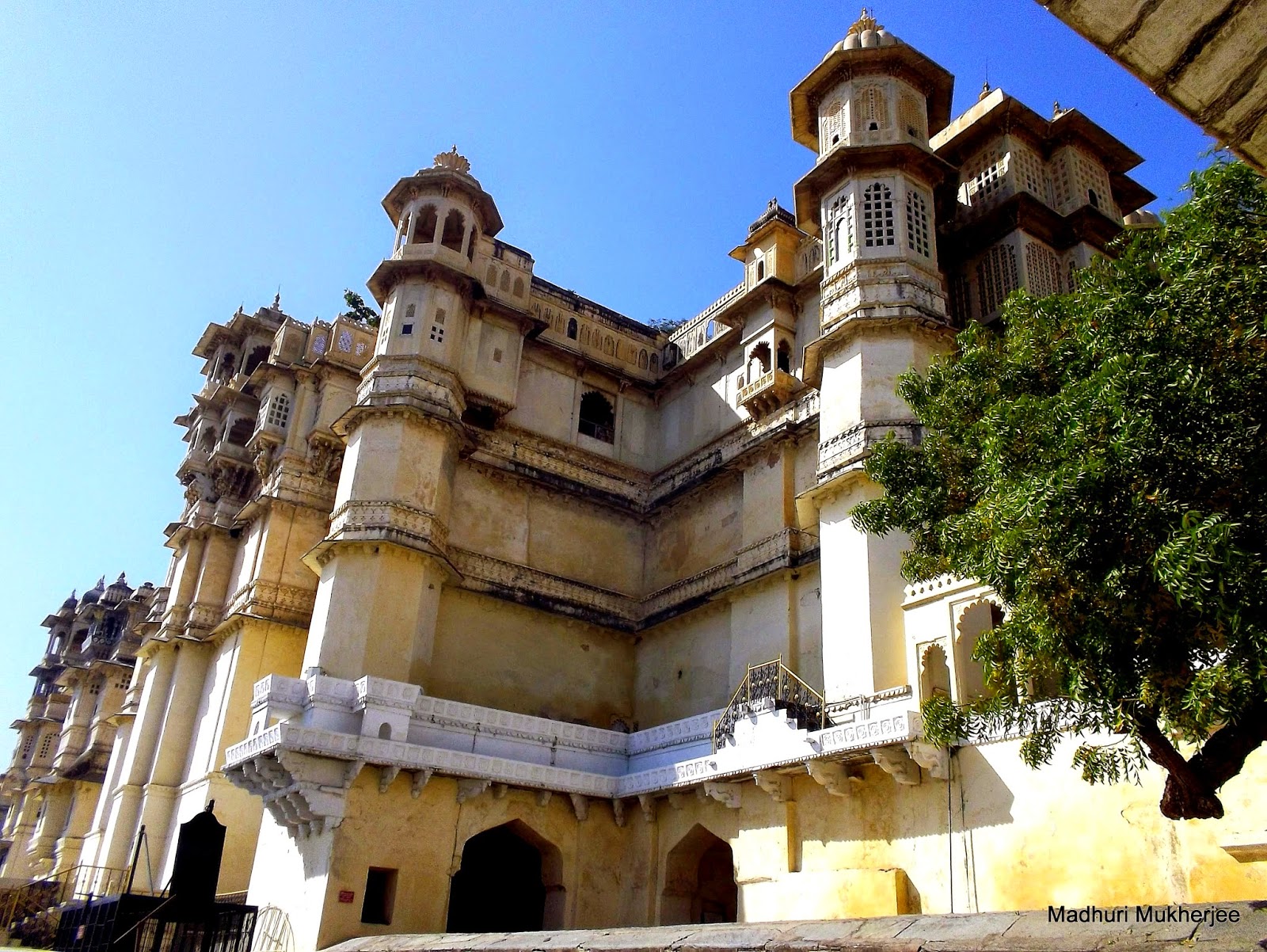
Entrance to the City Palace, Udaipur


3. Go for a cultural show at Bagore ki Haveli
Just in case the ghats, the city palace, Lake Pichola, the tiny shops selling silver jewellery weren’t enough to capture your heart, go for a cultural show in Bagore ki Haveli. These shows are organized every night and display the varied cultural heritage of Rajasthan. From Chhari dance (ladies dancing with pots balanced on their heads lit with fire) to Bhavai Dance (at least a dozen pots balanced on the heads) and dancing on broken glass, and puppet shows, this one hour is guaranteed to regale you!
Bagore ki Haveli on the ghats of Lake Pichola


4.  Definitely check out Kumbalgarh
Just about a 100km away from Udaipur, yet most people would have never heard about it. The Kumbalgarh fort is a Mewar fort, built on a hilltop which is around 1100m above sea level and has walls extending to around 38km, making it the second longest continuous wall after the Great Wall of China. From the top of the palace one can see kilometres into the Aravalli range.

Walls of the Kumbalgarh Fort


5. Only travel in local buses
Needless to say some of the best experiences that one can have is on local transport and Rajasthan is no less. With a landscape so dry, arid and barren, the colourfully dressed locals thronging all buses could not have provided starker contrasts! Also, these are the cheapest and some of the most entertaining ways to travel.

6. Walk up to Mehrangarh Fort

Finally, in Jodhpur, the most famous place of visit is the Mehrangarh Fort and it is worthy of that status. While visiting the fort, instead of driving all the way up to the entrance, it is better to go via the Clock Tower and actually climb up an extremely steep path of close to 2km. The path meanders through tiny houses, all painted in bright blue shades and on the way you’ll mostly encounter curious kids and happy go lucky goats!

Mighty Mehrangarh Fort


View of Mehrangarh Fort from Jaswant Thada
Jaswant Thada
                                                  
Mandor Garden
Umaid Bhavan Palace
Though these for me were some of the memorable moments, but my trip was made with the countless hours of waiting at bus-stops and train stations, of meeting warm strangers and striking up conversations, of watching sunsets and feeling lucky.