Showing posts with label history. Show all posts

Monday, 21 September 2015

Lessons from Birmanie!

They say life is not about the number of breaths we take, rather than the moments which take your breath away. And I’ve been more than lucky in that aspect to have had the opportunity to visit Myanmar (erstwhile Burma) for its magnificent landscapes, people beyond the definition of hospitable, art and architecture to satisfy your senses to no end and smiles and peace to greet you even in the most chaotic pick-up van!

While, soon there will be several posts detailing your journey which started from Mandalay, then a 2-day trek from Kalaw to Inle Lake, followed by 2 days at Inle Lake and the neighbouring regions, moving to Bagan for 2 more days and finally back to Mandalay and the neighbouring ancient cities! 
It sounds too much for just 8 days, and it did stretch us to our physically limits, but if we have to do it again, there’s nothing we would change!

While now I sit in my apartment, on a humid Sunday Bombay evening, I can’t stop thinking of snippets of the Myanmar trip and how much I learnt about history, geography and people in general in just those 8 days!

Lessons from Myanmar:

Smiling is a national mandate!
It is crazy, how can an entire nation always put up a smiling face?! Irrespective of the weather, the hardships in life, the spice in your curry, there is nothing that a smile cannot overcome! One night we reached our hostel post midnight and had to bang on the doors to wake up the owners inside, and wake they did with a resplendent smile! Everywhere we went the one thing common was the innocent smiles that greeted us!

First family we met on our trek to Inle Lake. And it was the first time they were seeing foreigners! So happy to have a polaroid to keep those memories forever!
Babies of Burma! On the trek to Inle Lake
So excited to show off his catch!
History does not define your future
Historically, the capital of Myanmar has mostly circulated between Inwa, Amarapura and Mandalay, the three ancient cities. We happened to visit Inwa on one of the days and unless we had specifically read about it’s royal history, there is pretty much no semblance to an erstwhile royal capital! Just goes on to show how if people don’t move ahead with times and still hold on to their heritage, they will neither belong to the past nor to the present.
Ruins at Inndain
More than a thousand pagodas at the Shwe Inn Thein
Bird's eye view of the Shwe Inn Thein

Indulge in the arts!
Almost everywhere one can see people setting up easels or mixing colours to paint the silhouette of a wooden monastery or the flaming colours of the setting sun or the life story of Buddha! Agreed, a lot of it is turning towards commercial consumption owing to increased tourism, however, it is still heartening to see old men with flowing white beards painting sunsets.
Just another morning at a monastery

Too much beauty in the same frame!

There is always time for football!
Footballs here are not what one is used to seeing, the colourful patches on a bouncy big ball. Instead it is fashioned out of bamboo (called a chemlo) and is considerably tinier but still clearly affords the same amount of fun to kids and adults alike. On most corners and alleys it’s not a rare sight to see young monks, with their maroon drapes tied around their waists running after the chemlo.
Chemlo is always a good idea!
At any time of the day!
With anyone!

Mass tourism is fast approaching!
Myanmar saw about 2 million tourists in 2013. Compare this to the 20 million that its neighbour Thailand saw in the same time. While in major tourist spots like Bagan you can see taxi drivers approaching the bus even before it has stopped at the station, at others like Manadalay (surprisingly) most locals just leave you alone as you walk about its crowded streets. While Myanmar is still one of the most pristine and untouched countries in south East Asia, it doesn’t seem like it will remain so for a very long time. It is up to people like us, who while should visit the country and savour its beauty and hospitality in all its glory, but also do it in a manner most responsible. Let’s not make it another Thailand.


Tuesday, 14 April 2015

Have you done the Diu??

“People seem to think embracing life means to jump off cliffs and kiss strangers. Maybe it’s just slowly learning to love yourself.”

Move over Gokarna, make way for the newest kid on the block – DIU!! With pristine beaches, old churches and forts, quaint Portuguese houses, caves and reefs and cheap alcohol supply next to Gujarat, Diu fulfils every requirement on the checklist to the become the next beach-hot spot-getaway (though I pray with all my heart and soul that it does not, just to maintain this very same sanctity)!!

So firstly, one must be warned that reaching Diu is not the easiest task ever. Redbus said the journey will take 18 hours from Mumbai, but after a few helpings of dhokla and thepla, that creeps to a good 22 hours. Yes close to a day in a bus with Govinda movies on repeat, so one can well imagine how beautiful Diu must have been to be worth it!

The first thing that strikes you is how clean the place is! You’ve got to give it to a Union Territory for such brilliant development and spic and span maintenance and a fabulously shot video to show the world the same. (Watch it here in case you still haven’t). The roads even have a separate path for cyclists!! *chuckles*

So we stayed at the Hoka Beach Resort, on Nagoa beach. Named after the Hoka trees on the beach (apparently the only place in India where these trees are found), the resort is cute, extremely hospitable, the staff a tad too slow in the kitchen but they make it up in their kindness.


First up was the Diu Fort. Built by the Portuguese in 1535, the fort was strengthened over the years till 1961 (which is also the longest period of colonial rule anywhere in the world!) Located at the southern tip of Gujarat at the mouth of the gulf of Khambat, the fort also has a large light house. It takes a good couple of hours to peacefully unravel all the gateways and arches and revel in the magnificent views of the sea.  Around the Fort area is the main city, and barring the heat at this time of the year it is a pleasure to walk around the narrow, albeit well-maintained roads, speak to the locals, sit in one of the several churches, or just sit by the dock and watch the ferries come and go.
View from the lighthouse, Diu Fort
Lighthouse, Diu Fort
Colourful houses in the city
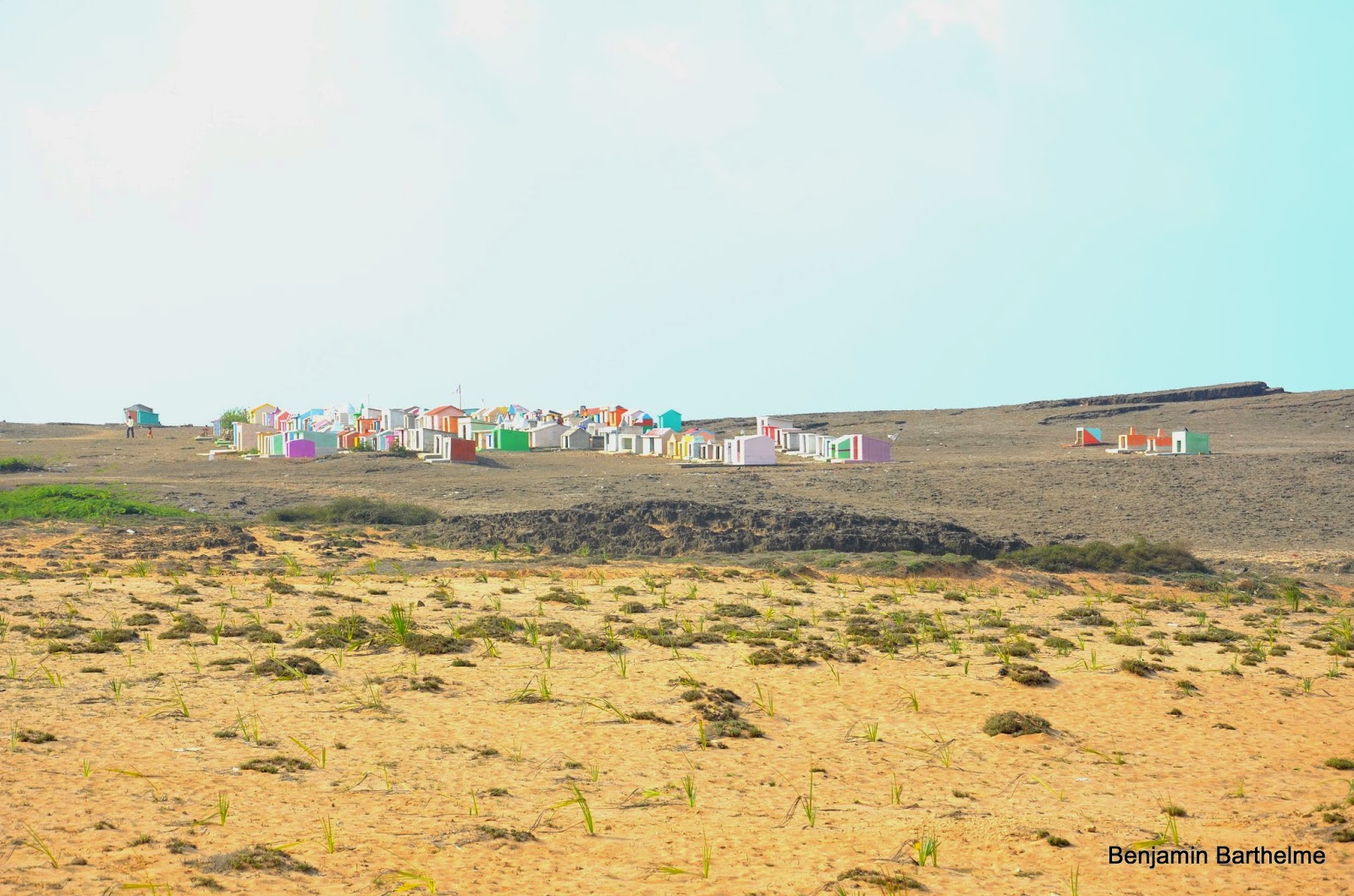
A few kilometres away to the south is the Gangeshwar temple. The Shiva temple has 5 shivalingas, said to have been constructed by the 5 Pandavas. Once a cave temple, now the shivalings lie open to the crashing of the waves and are completely submerged during high tides. The coast here is extremely jagged, in fact the beach is nothing but walking on reefs and hence not very tourist friendly and that’s what adds to the charm. With a few solitary benches placed across the entire stretch, one can just sit and hear the waves crashing and be at peace! Close by are the two “dakhmas” or Towers of Silence, a memorial for the undying spirit of the ancestors of the Parsi community.
Nagoa beach, is by far the most famous beach in Diu and rightly so. With clear waters (and water sports), lined by swaying Hoka trees, and reefs at one end, the beach, when not crowded can be a solace for many.

Near Gangeshwar Temple

Nagoa Beach
For our second day we decided to cycle the entire perimeter of Diu (at least 25km) and even though our butts were not very pleased post the effort, our senses and souls will forever be indebted!

There are hardly any places to rent a cycle from in Diu, its mostly motorbikes and scooty’s. We found our saviour in Safar Bike Rental (thanks Ixigo!). Starting from Diu city, we cycled through the narrow lanes to look for the Nagar Sheth Haveli, an old mansion, now a tourist attraction, done up in some of the most psychedelic colours! A few more kilometres took us to Naida caves. Enough cannot be said to describe the magnificence of these caves. Drama at it’s best. Apparently created after the Portuguese hacked away building material, with crevices and unfinished steps, beams of sunlight interspersed with darkness, dead leaves and dangling roots, the caves are a must visit for anyone in Diu!

Colourful Nagar Sheth Haveli
Naida Caves
More Naida caves

Near the fishing village
And finally, the last leg of our missive bike ride ended at the Gomtimata beach. Not a lot of people 
go there and it isn’t a beach in the usual sense (less sand, more reefs and cliffs) and yet again this only adds to the unbridled charm.


Near Gomtimata beach
All I can say is, we found our Island of Calm, and so must you!

Thursday, 23 October 2014

Gingee: The Hidden Treasure of Tamil Nadu

“Half the fun of travel is the aesthetic of lostness” – Ray Bradbury

Every person, every traveler has that one that one kind of place that they keep going back to..in their journeys through time and physical places and their minds. For some it may always be finding that secluded spot on a beach and counting the waves as they slowly die and reincarnate again and again, and for some it may be spending hours studying and watching people in a bustling market. For me it will always be the ruins. Nothing gives me the sense of satisfaction, of discovery, of peace and calm, of humility as sitting alone in the midst of ruins, imagining how a century ago, that very same spot could have been used to sell fruits in a Sunday market, or by a courtesan enthralling her audience, or by a king making important (or not-so-important) decisions! Just the time travel in my mind gives a sense of awe that nothing can parallel.

So while we were on our weekend getaway to Pondicherry (and getting bored out of our minds by the second day...no offence to Pondy lovers!), we decided to check out Gingee (yeah Lonely Planet had like one paragraph about it in their South India section, but just those few lines were captivating enough).
Gingee lies almost midway between Chennai and Pondicherry and it’s close to a two hours drive from the latter. 

The town is located between three hills and the most famous attraction of this otherwise nondescript town is the Gingee Fort. Gingee Fort (also known an Senji, Jinji, Senchi or Chenji) is one of the few surviving forts in Tamil Nadu and was tipped as the “most impregnable fortress in India” by the Maratha ruler Shivaji and the British were so kind as to call it the Troy of the East.
The Gingee Fort
Within the Gingee Complex
One of the many corridors to take you back in time
The Venkataramana Temple in the background
The site originally built by the Chola dynasty in the 9th century AD, has since then passed through the leadership of the Vijayanagara Empire, the Marathas, Bijapur sultans, the Mughals, French and finally the British. The complex is nestled between three hillocks: Krishnagiri to the north, Rajagiri to the west and Chandrayandurg to the south east. Apart from the fort, the complex houses a 7-story building called the Kalyana Mahal (marriage hall they say), granaries, prison cells, temples and several tanks. If you’re lucky then you’ll have almost the entire complex to yourself to explore and relish in peace, otherwise like us you may have to share it with bus loads of weekend travelers and school kids!

Though the complex in itself is absolutely beautiful, but your mind really begins to get blown when you start the uphill climb to the fort. The steps are more like huge slabs of rocks and climbing those can totally replace the lunges one does in the gym and to top that the climb is at least 45 degrees if not steeper. And if this wasn’t enough there will be monkeys jumping around trying to take your belongings just for fun or kids trying to race each other to the top or to the foot! But still, despite all this, with every few steps when you just look around, without fail one ends up heaving a huge sigh (party due to breathlessness), but mostly because there’s nothing else that you’d do at that very moment but soak in the feeling of (almost) being on top of the world!
View from on the way up
And yes, you'll usually find company
Before the climb I had read the ASI description about the fort being impregnable, but I truly understood the meaning when I got on top and realized that there was a real draw-bridge across a massive crevice which separated the actual fortress on the top from the rest of the structure! And crossing that bridge is not for the faint hearted, or those suffering from vertigo like me! At that height, with the winds howling, you feel like you’ll be blown away like a stray kite with every step that you take!
Ranganatha Temple on the way

What's a fortress without a draw bridge!

But once you finally station yourself on top, and look down at the rest of the world, the complex which would have once been teeming with people, the granaries with produce, the chants of the priest in the temples, the two other hillocks guarding the complex and everything else takes a back seat. In those few moments lie the little joys of life which make the rest of the weeks and months worth going through.
Venkataramana Temple complex
The temple replete with monolithic pillars


Near the complex is the Venkataramana Temple which was built by the Nayakas. This is usually comparatively more secluded than the inner fort, maybe because this edifice is actually quite secluded. The entire temple brims with large monolithic pillars, which adds the Mummy Returns sort of eeriness.

In short, Gingee is a jewel. When in Chennai or Pondicherry, it is a must visit!

Saturday, 18 October 2014

Bidding Adieu to Summer, Bilbao style!

“Bizarre travel plans are dancing lessons from God – Kurt Vonnegut”

This September I went back again to France (in an attempt to make this an annual thing, and make it sound all fancy!), and luckily for me, this year, the (European) weather Gods were in a much better mood! The 10 days that i was there i soaked up more sunshine than I actually ever have in Bangalore in the last 1.5 years!!

Since last year I had managed to cover a lot of places in France, so this year I decided to drive down further and visit the areas of the Basque Country which lie in Spain (obviously it’s a blessing when you have an adoring boyfriend willing to drive you down to wherever you want!)

Our first stop was Hondarribia.

Hondarribia, which in Basque means sand fort is a quaint border town located on the west shore of the Bidasoa river. The first thing that hits you when you step foot on here, is how different the pace of life is from France which is just a couple of kilometres away! Almost felt that the car ride was more than a ride, it was a journey back in time (or forward?!), to a space where good food, good ambience, walking by the beach, watching pristine white sailboats and colourful yachts on the deep blue waters, meandering aimlessly on cobbled streets define a way of life instead of the madness that consumes us as we run every morning from home to the gym to work to the local bar to back to bed. It was a Wednesday and we only planned to stop for a few quick hours to walk around the town, but it almost felt like in the middle of a festive season with kids running all over the place, people old and young sipping on wine and gulping down beer on the tiny bar stools that pockmarked every walkway and lively music floating through the air.

Apart from chilling, soaking in the good life and leaving all worries behind, the other things to do here would be to relax some more (!!) and maybe to visit the Ermita de Guadalupe, a small church situated on the hill top.

From postcard to reality!

Cobbled pathways of Hondarribia
Next up was the city, which is now a part of my ‘favourite cities’ list; Bilbao. Before coming, the usual things one would have heard about Bilbao were..umm nothing more than a small gritty industrial town, but it is magnificently surprising to see how culturally oriented the city has become with marvels of art to stumble upon at every second turn you take!

First up of course is the most famous attraction – the Guggenheim Museum. Designed by Frank Gehry, the building in itself is an architectural masterpiece. And even before you can enter the museum, you are hit by a blast of art by from the several installations around museum premises.


Installations outside the Guggenheim Museum

That moment of pride - Anish Kapoor at Guggenheim


The Guggenheim is situated right next to Casco Viejo, the old town which is full of charming streets, quaint houses, magnificent churches, boisterous bars, quirky shops and lots of good food!

When in Bilbao, one must try the pinxtos (Basque tapas), and we were just lucky to have landed right in the middle of the pinxto festival! This is when almost every pub (which double up as cafes during the day) serve their specialties and compete with each other to win the best pinxtos award!

Now since Bilbao is a valley town nestled between mountain ranges, it’s a pretty good use of one’s time there to take the funicular as it creaks and moans its way up Mount Arxanda from where one can get spectacular views of the entire city.
At Mount Artxanda

Sunset at Mount Artxanda

Finally on our way back to France, we decided to make on last stop at Donostia- San Sebastian. If ever you have dreamt of what the perfect beach would look like, then Playa de Concha and its extension Playa de Ondarreta would be the epitome of that dream! With the golden sandy beach stretching till the eyes can see, water more blue than you’ve ever witnessed, hundreds of toned bodies soaking up the sun, it is easily one of the best beaches I have ever been to! Walking towards the western part of the beach, you reach Playa de Ondarreta and if the sumptuous beach wasn’t enough to enthrall your senses, then definitely the sculptures embedded in the rocks would. The installations by Eduardo Chillida, create a mystical harmony between human art creations and the creations of nature. 
Playa de Concha

Installations at Playa de Ondarreta


San Sebastian, screams art, culture, history and positivity from every brick! No wonder it has been named as the European Center of Culture for 2016. One can spend hours walking around the old city, savoring the pinxtos followed by the churros, witness wedding celebrations at the Ayuntamiento de San Sebastian, laze around in the courtyard of the Plaza de Constitucion, walk up to the sculpture of Christ as the Good Shepherd or just check out the Aquarium at the end of the pier.
Plaza de Constitucion

It is true that visiting Spain is tantamount to a visit to India, it’s a collection of small nations working together, each with its own distinct art, flavour and culture and yet fusing together so effortlessly. A weekend in the Basque region will most probably be spent OD-ing on art and beauty and letting the smells and tastes overwhelm your senses.


These are not the most advertised European destinations, but by far one of the most beautiful and fulfilling journeys I have taken.